

Last Updated: October 25, 2026
Quick Summary
To choose the right size inflatable hot tub, start with how many people will soak weekly, then subtract about a third from the advertised seat count for a realistic comfortable capacity. Measure your tallest user's leg length and each user's shoulder width, and compare that sketch to the tub's interior dimensions, not its exterior.
- A four-person tub soaks two to three adults comfortably, while a six-person tub soaks four.
- Round tubs suit open patios, while square tubs use corner space better on tight balconies.
- Multiply water capacity in gallons by 8.34 pounds per gallon to get water weight.
- Residential decks are commonly designed for around 40 psf live load.
- Smaller tubs heat faster and hold temperature with less effort than larger tubs.
Table of Contents
- Start With How Many People Will Actually Use It
- Inflatable Hot Tub Capacity: Advertised Seats vs. Comfortable Seats
- Inflatable Hot Tub Dimensions: What the Numbers Tell You
- Square vs Round Inflatable Hot Tub: Which Shape Fits Your Space?
- Inflatable Hot Tub Weight When Filled: Can Your Deck Hold It?
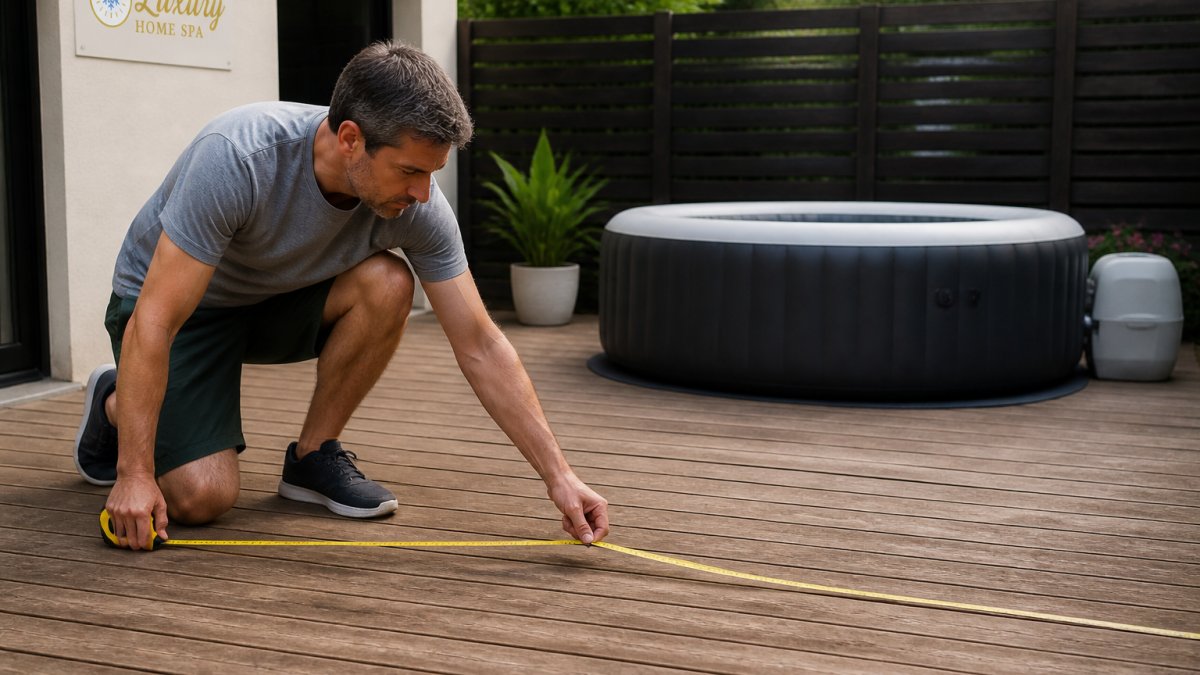
- Measuring Your Installation Space and Clearance
- Height, Depth, and Getting In and Out Safely
- Heating Costs and Energy Use by Tub Size
- Request Pricing and Recommendations for Your Space
- Frequently Asked Questions
Start With How Many People Will Actually Use It
Most people buy an inflatable hot tub for the idea of a hot tub, not for a headcount. That is the first mistake. Before you compare a single model, answer one question: how many bodies will be in the water on a normal Tuesday night, not on a holiday weekend?
If you are choosing the right size inflatable hot tub, the honest answer usually lands lower than you expect. A couple who hosts friends twice a year does not need a six-person spa. A family of five with teenagers will fight over a four-person model within a month.
Here is how we tell customers at My Luxury Home Spa to run this math:
- Count the people who live in the house and will use it weekly.
- Add one seat of buffer for a guest.
- Ignore the "entertaining" scenario unless you host often.
- Think about how each person sits: legs stretched out, or knees bent?
That last point matters more than most guides admit. Two adults who want to stretch out flat need roughly the same footprint as four adults sitting upright. Comfort is about legroom and elbow room, not just seat count.
Write the number down. Everything else in this guide builds on it.
Inflatable Hot Tub Capacity: Advertised Seats vs. Comfortable Seats
Inflatable hot tub capacity is where marketing and reality part ways. A "six-person" label means six adults can technically fit. It does not mean six adults will be comfortable.
Think of it like a car. A five-seat sedan carries five people, but the middle back seat is for short trips only. Inflatable hot tubs work the same way. The advertised number assumes everyone sits upright with knees together. Real soaking involves shifting, stretching, and a drink within reach.
Comfortable capacity is the number of adults who can soak without touching shoulders. As a rule of thumb, subtract about a third from the advertised figure for a realistic count. A four-person tub soaks two to three adults well. A six-person tub soaks four comfortably.
Two-Person, Four-Person, and Six-Person Models Compared
Each size class serves a different household, and the trade-offs are real.
Two-person models suit couples and solo soakers. They heat faster, use less water, and fit on a small patio. The catch is zero room for guests, and taller users may find the interior tight.
Four-person models are the sweet spot for most households. Two adults soak with room to spare, or three sit comfortably. The footprint stays manageable for a standard deck.
Six-person models fit families and regular hosts. They cost more to buy and more to run, and they need a bigger, sturdier surface. For a real look at what a six-person inflatable offers, the MSpa Oslo 6-Person Premium Portable Hydrotherapy Spa shows the specs and seating layout up close.

| Size Class | Advertised Seats | Comfortable Adults | Best For |
|---|---|---|---|
| Two-person | 2 | 1-2 | Couples, solo soakers, small patios |
| Four-person | 4 | 2-3 | Most households, small families |
| Six-person | 6 | 4-5 | Families, frequent hosts, larger decks |
Inflatable Hot Tub Dimensions: What the Numbers Tell You
Inflatable hot tub dimensions tell you two things: whether the tub fits your space, and whether it fits your people. The listed diameter or width is the outside edge. The usable interior space is smaller, often by several inches on each side because of the walls and pump housing. Most guides leave you there, comparing a number on a box to a number on a tape measure. The more useful approach is to work backward from the people who will actually sit in the water.
A Practical Sizing Calculator Based on Real Body Dimensions
Instead of guessing from the advertised seat count, translate headcount, body size, and desired elbow room into a recommended tub diameter or footprint. Here is the method we walk customers through. It takes five minutes and a tape measure.
- Measure your tallest user's leg length from floor to hip while seated. A common adult figure is about 18 to 20 inches from seat to knee, and roughly 30 to 34 inches from hip to heel when legs are extended.
- Add the depth of the tub wall plus a few inches of clearance for knees. Inflatable walls and the pump housing typically eat 4 to 6 inches on each side.
- Measure shoulder width for each regular user. A common adult shoulder width is about 16 to 18 inches. Two adults side by side need roughly double that width plus a gap of 4 to 6 inches so shoulders do not touch.
- Sketch the interior circle or square at those dimensions on paper. For a round tub, the interior diameter must be at least the widest pair's combined shoulder width plus the gap. For a square tub, the interior side length must clear the longest leg extension plus knee room.
- Compare your sketch to the tub's listed interior space, not its exterior. If the sketch feels crowded, size up.
Worked Examples: Two Adults vs. Four
- Two adults who want to stretch out: combined shoulder width of about 34 inches plus a 6-inch gap means an interior diameter of at least 40 inches just for shoulders. Add leg extension of about 30 inches in front of each seat, and a round tub with an interior diameter in the mid-50s to low 60s inches is the realistic minimum. A tub advertised as four-person often lands here once the walls are subtracted.
- Four adults sitting upright: two pairs of shoulders across the circle need roughly 70 to 80 inches of interior circumference at seat level. That pushes you toward a six-person exterior footprint, which is why the advertised count and the comfortable count diverge.
Water capacity matters too. More water means more weight, longer heating time, and more chemical use. A small tub might hold a few hundred gallons; a large one holds considerably more. That difference shows up in your electric bill and your maintenance routine, and it is the bridge to the weight calculation in the next section.
Square vs Round Inflatable Hot Tub: Which Shape Fits Your Space?
Shape is the most overlooked decision in this whole process. Square and round tubs hold similar water volume, but they fit rooms and bodies differently.
Round tubs spread seating evenly around the circle. Everyone faces the center, which makes conversation easy. They suit open patios and corners where a curve looks natural.
Square tubs use corner space better. They fit neatly against walls and fences, and the flat sides give more usable interior room per inch of footprint. For tight patios and balconies, a square model often wins.
Ask yourself where the tub will live. A narrow city balcony favors square. A wide-open deck favors round. If you are short on space, browse small hot tubs for compact spaces to see what actually fits a patio or balcony footprint.
Inflatable Hot Tub Weight When Filled: Can Your Deck Hold It?
Inflatable hot tub weight when filled is the number that decides whether your deck becomes a spa or a repair bill. Water weighs a lot. Add the tub, the occupants, and the equipment, and the total load climbs fast. Most guides stop at "check your deck," but the useful version of this step is a real calculation you can run in five minutes with a tape measure and the specs on the box.
Run the Load Math, Not Just the Total
Here is the calculation to run, using a mid-size four-person tub as a worked example:
MSpa Aurora Inflatable Hot Tub →
- Water weight: multiply the water capacity in gallons by 8.34 pounds per gallon. A tub holding 210 gallons carries about 1,750 pounds of water.
- Tub and equipment: add the dry weight of the shell, cover, and pump, typically 70 to 100 pounds for an inflatable model.
- People: add about 150-200 pounds per adult, plus the water they displace (which is already counted in the tub's capacity, so do not double-count it).
- Total: that is the load your surface must carry. In this example, roughly 2,000 pounds before occupants, and about 2,600 pounds with three adults.
A small tub holding a few hundred gallons already weighs well over a ton once filled. A large six-person model can push past two tons. Most raised wooden decks were not built for that concentrated load.
Convert Total Weight to Load per Square Foot
Deck ratings are usually expressed in pounds per square foot (psf), not total pounds, so the number that matters is the tub's footprint. Divide the total filled weight by the tub's footprint area.
- A round tub 77 inches across has a footprint of about 32 square feet. At 2,600 pounds loaded, that is roughly 81 psf.
- A square tub 73 inches on a side covers about 37 square feet. At the same load, that is about 70 psf.
Residential decks are commonly designed for around 40 psf live load, though older decks and small balconies may be lower. A filled hot tub concentrates load well above that in the tub's footprint, which is why placement and reinforcement matter more than the total weight alone.
Where the Load Actually Goes
A tub does not spread its weight evenly across the whole deck. The inflated floor bears on the deck surface, and the load transfers to the joists and beams beneath. Two placements change the picture:
- Across joists spreads load over more framing members than between joists, which concentrates it on the decking.
- Near a beam, post, or exterior wall puts load closer to the deck's supports than the middle of a span.
If the tub must sit on a raised deck, position it over or near the structural supports and consider having a contractor add blocking or a dedicated pad. A concrete patio, a reinforced deck, or a properly prepared ground pad is the safer default. If you are unsure, have a structural professional check the deck before delivery. Our guide on how to prepare your backyard for hot tub installation covers surface prep and support in detail.
Measuring Your Installation Space and Clearance
Measure twice, fill once. Clearance is the gap between the tub and everything else, and it needs to cover more than the tub itself.
Measure these distances:
- Tub footprint plus a few inches on every side for the inflated walls.
- Access path from the delivery point to the final spot. A filled tub does not move.
- Power outlet distance. The pump and heater need to reach an outlet, and long extension cords are a bad idea for high-draw equipment.
- Overhead clearance if the tub sits under a roof or awning, for steam and cover lift.
- Walking room around the tub for entry, exit, and maintenance access.
Check the path before you buy. A tub that cannot fit through the gate is a tub that sits in the driveway.
Height, Depth, and Getting In and Out Safely
Height and depth affect comfort more than most buyers expect. A deeper tub means more water over your shoulders. A taller wall means a bigger step to climb.
For older adults and anyone with knee or hip issues, entry and exit are the deciding factor. Look for these features:
- A lower wall height that shortens the step in.
- A firm, inflated floor that does not sag underfoot.
- A step or spa step placed beside the entry point.
- A grab handle or sturdy cover edge to steady yourself.
A deep, tall tub feels luxurious until the first slippery exit. If mobility is a concern for anyone in the household, prioritize a shallower model with an easy step. Comfortable soaking should not require a ladder.
Heating Costs and Energy Use by Tub Size
Bigger tubs cost more to heat. That is not a marketing claim; it is physics. More water takes more energy to bring to temperature and more energy to hold there.
Smaller tubs heat faster and hold temperature with less effort. Larger tubs take longer to reach your target water temperature and lose more heat across a bigger surface. The cover, the ambient air temperature, and how often you run the jets all shift the number.
Ways to keep operating costs down:
- Keep the cover on whenever the tub is empty.
- Set a realistic water temperature and leave it there.
- Run the air bubbles and jets when you are in the tub, not all day.
- Insulate the ground beneath the tub with a mat or pad.
- Check the pump and heater settings against the owner's manual.
Water care ties directly into cost. Clean, balanced water means less chemical use and fewer drain-and-refill cycles, both of which save money over a season. Our guide on how to maintain hot tub water walks through the routine that keeps a tub running efficiently.
Request Pricing and Recommendations for Your Space
You now have the numbers that matter: people, footprint, filled weight, and clearance. The last step is matching those numbers to a model that fits your home and your budget.
At My Luxury Home Spa, we are a veteran-owned, authorized dealer of premium wellness equipment. Every product we sell is 100% authentic and backed by its full manufacturer warranty. We help customers match tub size to their actual space, not to a sales sheet.
Two models worth a close look:
- The MSpa Aurora Inflatable Hot Tub at $849.00 is a strong entry point for couples and small patios.
- The MSpa Tekapo Inflatable Hot Tub at $549.00 offers a compact footprint at the lowest price in the lineup.
If you want a plug-and-play option that skips the electrical work, browse our hybrid plug and play hot tubs and request pricing for your space. Free delivery applies to most items, and flexible payment options are available.
Frequently Asked Questions
What size inflatable hot tub do I need for four people?
A four-person inflatable hot tub typically measures around 70 to 77 inches across and holds roughly 200 to 250 gallons. That works for four adults sitting upright, but if anyone wants to stretch out, plan on a six-person model instead. Measure your patio first: a four-person round tub needs about 6 feet of clear width plus at least 2 feet of clearance on each side for the pump, cover, and safe entry.
Does a larger inflatable hot tub cost more to heat?
Yes. Heating cost tracks water volume, so a six-person tub with more gallons takes longer to reach temperature and uses more electricity to hold it there. A smaller two- or four-person model heats faster and costs less to run. Keeping a fitted cover on whenever the tub is empty, and setting a lower standby temperature during the week, reduces the gap between sizes considerably.
Can my deck support the weight of a filled inflatable hot tub?
It depends on the deck. Water weighs about 8.3 pounds per gallon, so a 250-gallon tub carries over 2,000 pounds of water before you add occupants and the tub itself. Standard wood decks are often rated for 40 to 50 pounds per square foot, and a filled tub can exceed that. Have a qualified inspector or structural engineer confirm your deck's load rating before filling, or place the tub on a reinforced concrete patio instead.
Is a square or round inflatable hot tub better?
Round tubs spread weight more evenly and usually cost less for the same water volume. Square tubs use corners more efficiently, which helps on narrow patios and in households where people want to sit facing each other. If space is tight or the tub goes against a wall, a square model often fits better. For open backyard placement and simpler setup, a round tub is the easier choice.
Sizing an inflatable hot tub comes down to honesty about your household and your deck. Get those two right, and the rest is easy. My Luxury Home Spa carries authentic, warrantied inflatable hot tubs with free delivery on most items and flexible payment options, and our team will help you match the right model to your space. Get started with My Luxury Home Spa and turn your patio into a personal wellness retreat.


Leave a comment