

Last Updated: October 4, 2026
Quick Answer
Before your hot tub arrives, choose a location with privacy, suitable drainage, and enough room for delivery and future service. Prepare a level base that can support the filled spa, confirm the delivery route, and have a licensed electrician verify the model’s electrical requirements. Check local permit and building code requirements before construction begins.
Step 1: Choose a Suitable Backyard Location
Choosing the right spot for your backyard hot tub installation is the foundation of everything that follows. The location affects water temperature, maintenance costs, privacy, noise levels, and equipment longevity.
A location with 4-6 hours of direct sunlight keeps water warm and reduces heating costs, but too much sun causes algae growth and chemical imbalances. Partial shade works best. Trees provide natural screening but drop leaves and debris, increasing maintenance.
Position the spa away from neighbors' windows and bedrooms. A fence or landscaping barrier contains noise and creates privacy. Also consider sightlines from your home, you'll use it more if visible and accessible from inside.
Assess sun exposure and shade
Direct sunlight warms your spa naturally but can accelerate water degradation. Morning sun is gentler than afternoon heat. If your backyard gets full afternoon sun, plant shade trees or install a pergola to filter harsh rays. This balance saves money on heating while protecting your equipment.
Consider privacy and noise factors
Neighbors appreciate quiet. Position the spa at least 15 feet from property lines if possible. Solid fencing blocks sound better than open designs. If you're on a smaller lot, sound-dampening materials around the perimeter help. Also think about sightlines from your own home, you'll use the spa more if it's visible and inviting from inside.
Step 2: Measure and Inspect Delivery Access Routes
Measure everything before purchasing. A hot tub won't fit if your delivery route is too narrow, causing expensive delays or refusals on delivery day.
Measure gate widths carefully. Most residential gates are 3-4 feet wide, but many hot tubs are 5-7 feet across. Measure the actual opening, not the frame, and account for hinges. If too narrow, delivery crews may need to remove fencing temporarily.
Measure all doors and hallways the spa must pass through. If no interior route works, outdoor access becomes critical.
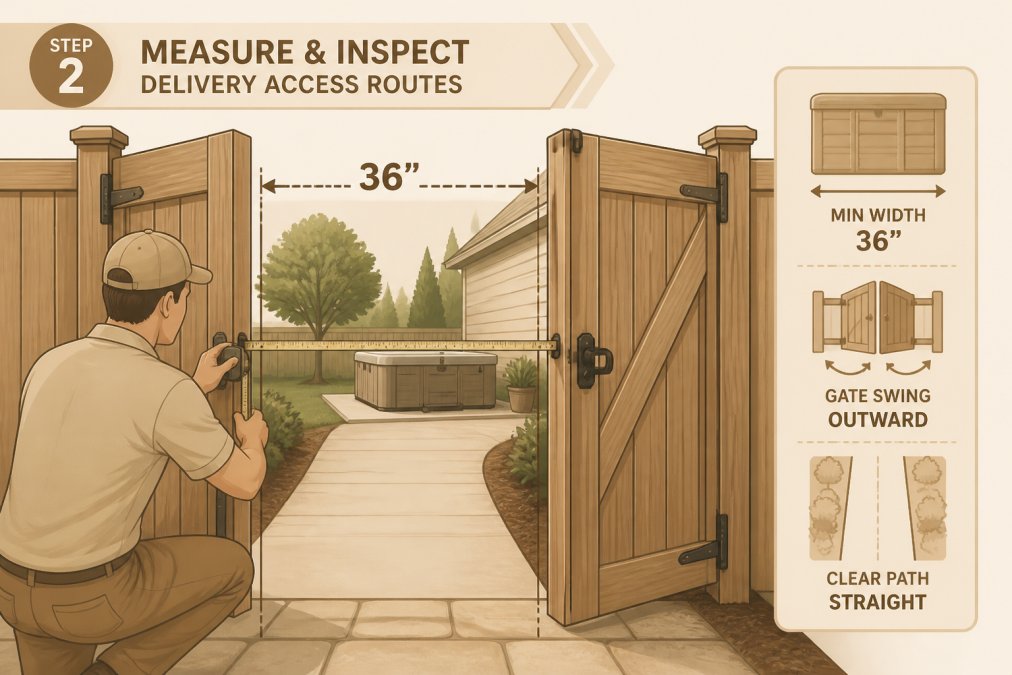
Walk the entire delivery route from street to installation site and note low-hanging branches, power lines, garden beds, parked cars, steps, and narrow passages. Communicate these details to the delivery team before scheduling.
Check gate widths and doorway dimensions
Measure twice. A gate that appears wide enough might not be. Account for the diagonal angle delivery crews use to maneuver large items. If your gate is 4 feet wide, a 5-foot hot tub can't pass through at any angle. Some homeowners must remove gate hinges or temporarily disassemble fencing.
Clear obstacles and plan the delivery path
Mark the path clearly before delivery day. Remove garden hoses, toys, and outdoor furniture. Trim branches that hang below 8 feet. Let your neighbors know delivery is happening, crews may need brief access to their property. A clear path prevents damage to your yard and saves the delivery team hours of work.
Step 3: Prepare a Level, Structurally Sound Foundation
A hot tub filled with water weighs thousands of pounds. Your foundation must support that load without shifting or settling. An uneven surface causes structural stress, leaks, and equipment failure. This step is non-negotiable, a poor foundation leads to cracks, leaks, and repairs that cost far more than proper preparation.
Calculate the load and assess soil conditions
A typical hot tub holds 400-600 gallons of water, weighing 3,300-5,000 pounds. Add the shell (500-1,500 pounds), equipment, and people (4-8 at 150-200 pounds each). Total load often reaches 6,000-8,000 pounds or more.
Assess your soil. Soft, sandy, or clay-heavy soil compacts poorly and shifts under load. Walk the site after heavy rain. If water pools or the ground feels spongy, you have a drainage problem that must be solved before installation.
For uncertain soil, dig a test hole 12 inches deep and fill it with water. If water remains after 24 hours, you need a drainage layer. If it drains within a few hours, your soil is acceptable.
Foundation dimensions and specifications
Your foundation pad must be at least as large as the hot tub's footprint, plus 6-12 inches on all sides. For a typical 7×7 foot hot tub, prepare an 8×8 or 9×9 foot base. The ground must be level within 1 inch over 10 feet. If your yard slopes, build up the low side with compacted soil or choose a different location.
Concrete pads: the premium option
A 4-6 inch reinforced concrete slab is the gold standard, lasting 20+ years. For a 10×10 foot pad, expect $400-$1,200. Specify 4-inch minimum thickness (6 inches for freeze-thaw climates), 4×4 inch wire mesh reinforcement, slight slope away from the spa, and 7 days curing before installation. Concrete is ideal for permanent installations or poor soil.
Crushed stone: the balanced choice
Crushed stone (3/4 inch minus) is the most common choice, costing $100-$400. Excavate 4-6 inches, compact the subgrade, spread stone in 2-inch layers compacting each, and level within 1 inch. Add landscape fabric to prevent settling. Crushed stone requires occasional maintenance and works well in most residential yards with decent drainage.
Pea gravel: the budget option
Pea gravel costs $50-$150 but is the least stable option. It shifts under load and requires frequent raking. Reserve it for temporary installations only. Lay landscape fabric underneath and expect to add fresh gravel annually.
When to hire a professional assessment
Hire a soil engineer ($200-$500) if your yard has poor drainage, mostly clay or sandy soil, a slope greater than 5 degrees, a large hot tub, or freeze-thaw climate. A professional prevents costly repairs later.
Checking levelness and preventing settling
Use a 4-foot level to verify levelness in multiple directions, including diagonally. Mark and correct high or low spots. Monitor the spa for the first few months, slight settling (less than 1/4 inch) is normal. If uneven settling or tilting occurs, contact the retailer immediately.
| Base Type | Cost | Durability | Compaction Effort | Best For |
|---|---|---|---|---|
| Concrete pad (4-6 in.) | $400-$1,500 | 20+ years | Professional installation | Permanent installations, freeze-thaw climates, poor soil |
| Crushed stone (4-6 in.) | $100-$400 | 5-10 years | Moderate (plate compactor) | Most residential yards with decent drainage |
| Pea gravel (4-6 in.) | $50-$150 | 2-5 years | Minimal | Temporary or rental situations only |
Step 4: Check Overhead Clearance and Drainage
Measure overhead clearance, most hot tubs need at least 8 feet of clear space. Trim branches back 5-10 feet from the planned location. Check roof overhangs and gutters; if they drain toward the spa, redirect the downspout or create a drainage trench. Ensure the ground slopes slightly away from the spa so rain doesn't pool. If your yard stays wet, add drainage rock or a French drain before installation. Persistent moisture issues often require a more comprehensive approach to fix backyard drainage before you can safely finalize your site preparation.
Identify low-hanging branches and roof overhangs
Branches lower than 8 feet overhead will interfere with spa use and maintenance. Trim them back generously. Gutters that drain toward your spa location require rerouting. Both issues are cheap to fix before installation and expensive to ignore afterward.
Plan for drainage and ground stability
Ensure water drains away from the spa, not toward it. A slight slope (1/4 inch per foot) is ideal. If your yard is flat or slopes toward the spa location, create a drainage solution. Compacted crushed stone beneath the base helps water percolate down instead of pooling.
Step 5: Verify Hot Tub Electrical Requirements
Improper electrical installation causes most hot tub failures and safety hazards. Work with a licensed electrician to prevent delays, code violations, and fire hazards. Do not attempt DIY electrical work.
Determine your hot tub's electrical requirements
Hot tubs require either 110V or 240V power. Small plug-and-play models (2-3 person) can use standard 120V outlets, but heating is slow (8-12 hours). 240V is standard for residential spas, heating 2-3 times faster (2-4 hours to 104°F). Check your spa's manual for exact voltage and amperage requirements. Common 240V spas require 40-60 amps; larger models need 100 amps.
Understand dedicated circuits and GFCI protection
A dedicated circuit is non-negotiable for safety and performance. GFCI (Ground Fault Circuit Interrupter) protection is required by the National Electrical Code for all spa circuits. A GFCI breaker detects ground faults and shuts off power in milliseconds, preventing electrocution. The NEC also requires a disconnect switch within 5 feet of the spa for safety.
Luxury Spas Galley Elite Series Luxury Home Hot Tub →
Plan the electrical run and assess costs
Electrical installation cost depends on distance from your main panel to the spa. Short runs (under 50 feet) cost $500-$1,200. Medium runs (50-100 feet) cost $1,200-$2,500. Long runs (over 100 feet) or panel upgrades cost $2,000-$5,000 or more. Measure the distance to give your electrician a baseline estimate.
Checklist for your electrical inspection
Schedule an inspection with a licensed electrician before purchasing. Ask about your home's total amperage, available capacity for a 40-60 amp circuit, your spa's voltage and amperage requirements, distance from panel to spa, wire type and gauge needed, whether the wire runs underground or overhead, permit requirements, GFCI protection, disconnect switch location, estimated cost, timeline, and who obtains the permit.
Permitting and inspection
Electrical work for hot tubs requires a permit in most jurisdictions. The permit ensures the work meets code and protects you legally. Unpermitted electrical work can:
- Void your homeowner's insurance
- Create fire hazards
- Cause problems when selling your home (inspectors will flag unpermitted work)
- Result in fines from your local building department
Your electrician typically handles the permit application and inspection. Confirm this before hiring. The inspection usually happens after the work is complete and before the spa is filled. Budget 1-2 weeks for permitting and inspection.
Timing and coordination with installation
Electrical work must be complete and inspected before the spa is delivered and filled. Schedule your electrical work 2-4 weeks before your planned delivery date. This allows time for permitting, work, and inspection without rushing.
Communicate your delivery date to your electrician so they can schedule accordingly. If electrical work is delayed, you may need to postpone delivery.
Step 6: Create a Backyard Hot Tub Installation Checklist
Organization prevents last-minute surprises. Use this checklist to track preparation tasks and timeline.
8-12 weeks before delivery:
- Choose your backyard location
- Measure gate widths and doorway dimensions
- Clear obstacles from delivery route
- Select your hot tub model
- Schedule electrical inspection
- Plan foundation type and preparation
4-8 weeks before delivery:
- Prepare the foundation (concrete, stone, or gravel)
- Arrange electrical upgrades if needed
- Obtain permits and building permits if required
- Trim overhead branches
- Plan drainage solutions
- Confirm delivery date with retailer
1-2 weeks before delivery:
- Final site inspection and measurements
- Prepare delivery access (clear final obstacles)
- Arrange for someone to be home during delivery
- Gather tools needed for setup (hose, chemicals, cover)
- Review delivery instructions from manufacturer
Delivery day:
- Verify foundation is level and ready
- Clear a staging area near the installation site
- Have water source accessible (garden hose)
- Confirm electrical work is complete and inspected
- Take photos of spa condition upon arrival
- Review setup instructions with delivery crew
First week after delivery:
- Fill the spa and test all systems
- Balance water chemistry
- Test heating and jets
- Review warranty documentation
- Schedule maintenance routine
Timeline and pre-delivery tasks
Start planning 3-4 months before your target installation date. Foundation preparation takes time. Electrical work requires permits and inspections. Rushing creates problems. A realistic timeline prevents stress and costly mistakes.
Delivery day coordination and post-installation setup
Be present during delivery. Confirm the spa arrives undamaged. Verify the delivery crew places it exactly where you want it. Once positioned, moving it is extremely difficult. Have water and electrical hookups ready. Most retailers, including My Luxury Home Spa, provide setup guidance, but having everything prepared speeds the process.
Step 7: Plan for Permits and Building Code Compliance
Requirements vary by location. Some jurisdictions require permits for hot tub installation. Others have setback requirements (minimum distance from property lines). Building codes address electrical safety, foundation requirements, and drainage.
Contact your local building department before installation. Ask about:
- Permit requirements for hot tub installation
- Setback distances from property lines
- Electrical code requirements
- Foundation specifications
- Drainage and grading requirements
- Fencing or enclosure requirements
Many jurisdictions require permits for electrical work but not the spa itself. Some areas have specific rules about hot tub placement. A few minutes of research prevents costly compliance issues later. If you need to modify your planned location due to code requirements, it's better to learn this before digging the foundation.
Step 8: Ensure Equipment and Maintenance Access
Plan for long-term access, not just installation day. You'll need to service your spa regularly.
Ensure there's a clear path from your home to the spa. You'll carry chemicals, tools, and supplies regularly. A 3-foot-wide path prevents damage to landscaping and makes maintenance easier.
Leave space around the spa for equipment access. Pumps, filters, and heaters need occasional servicing. If your spa is tucked into a corner with fencing on three sides, a technician can't access the equipment. Plan for at least 2 feet of clearance on at least one side.
Consider future removal. If you ever want to remove or relocate the spa, access matters. A spa wedged against fencing or structures is expensive and difficult to remove. Leave yourself options.
Preparing your backyard properly transforms the installation experience. A level foundation prevents leaks and structural problems. Clear delivery access avoids expensive complications. Proper electrical service ensures safe operation. When you're ready to invest in a premium hot tub, My Luxury Home Spa provides expert guidance and authorized dealer products backed by full manufacturer warranties. Our team helps you select the right model and coordinates delivery logistics. Request pricing and recommendations today to start your journey toward a personal wellness retreat.


Frequently Asked Questions
What should I do before my hot tub arrives?
Before delivery, confirm your foundation is level and structurally sound, verify electrical service is installed and inspected, clear all obstacles from the delivery route, measure gates and doorways to ensure access, check overhead clearance for branches and gutters, and arrange for someone to be present on delivery day. Have your site prepared at least one week before arrival so you can address any last-minute issues.
What is the best base for an outdoor hot tub?
A concrete pad is the most durable and recommended option for hot tub bases. It provides excellent load-bearing capacity and prevents settling. Crushed stone or pea gravel are budget-friendly alternatives but require regular maintenance to stay level. The filled weight of most hot tubs ranges from 3,000 to 6,000 pounds, so your base must support that load without shifting or sinking.
Does a hot tub need a dedicated electrical circuit?
Yes, hot tubs require dedicated electrical service. Most models need either a 110-volt standard outlet or a 240-volt dedicated circuit, depending on the model. A licensed electrician must install and inspect the electrical setup to meet local building codes and ensure safety. Check your hot tub's specifications before installation to determine exact power requirements.
How do you get a hot tub into a backyard?
Plan your delivery route by measuring all access points: gates, doorways, and pathways. Clear obstacles like furniture, plants, and debris. The delivery team typically uses a dolly or hand truck to move the hot tub from the truck to its location. Ensure the path is clear, level, and wide enough for equipment. Some larger models may require crane access if traditional routes are blocked.


Leave a comment