

Last Updated: October 9, 2026
The Real Price of a Premium Hot Tub: What Your Money Buys
A premium hot tub costs more because it's built from heavier materials, insulated for year-round use, and backed by coverage that budget models rarely match. At My Luxury Home Spa, we hear the same question constantly: why does a luxury spa cost several times what a big-box inflatable does? The honest answer is that cheap and premium hot tubs are different products that share a name.

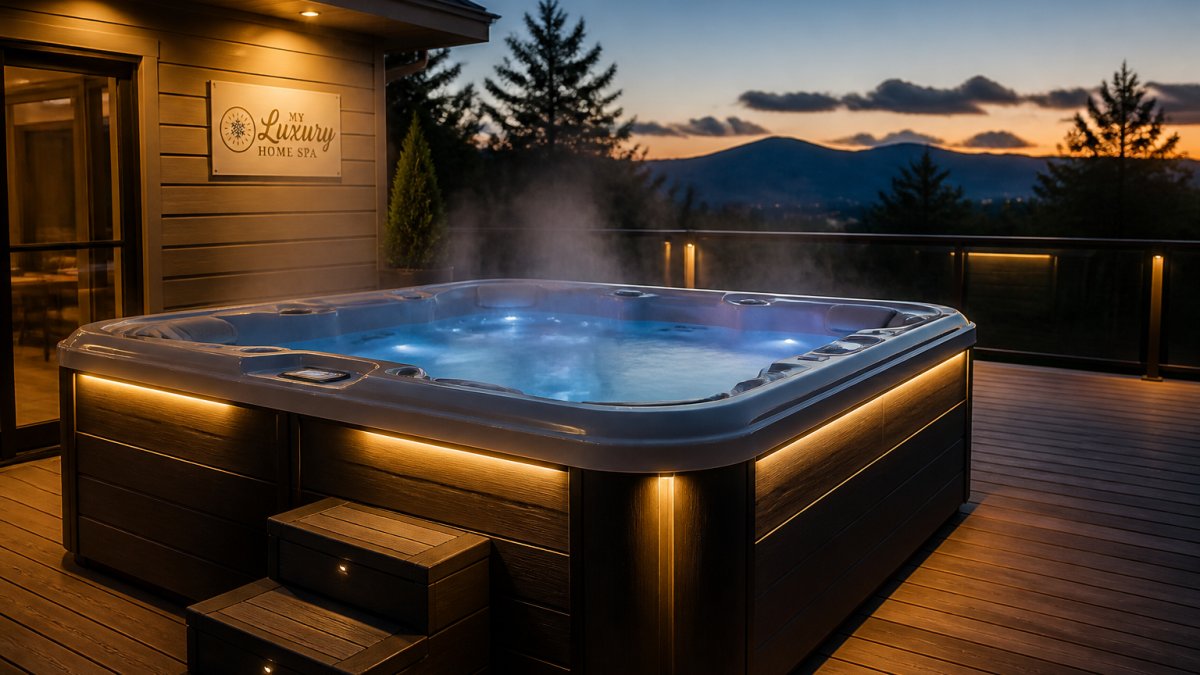
Total cost of ownership is the number that matters, not the sticker. Purchase price is only the first payment. Energy, water care, repairs, and replacement parts follow you for a decade or more. A spa that's cheap upfront often costs more per year than a premium one.
The U.S. Department of Energy guidance on pool and spa heating notes that heating accounts for the largest share of a spa's running cost, which is why insulation and pump efficiency separate premium from budget more than any feature list does.
Below, we'll break down exactly where the money goes: shell and cabinet construction, jet systems, insulation, warranty terms, and repairability. You'll also see who genuinely benefits from premium features, and who is paying for things they'll never use.
Premium Hot Tub Features That Drive the Price Up
Premium hot tub features separate a spa built for fifteen years of daily use from one built for a few seasons. The price gap traces to a short list of components, and each one shows up in how the spa feels, runs, and lasts.

Shell, Cabinet, and Construction Quality
The shell and cabinet are where build quality starts. A premium shell uses thicker acrylic backed by multiple layers of hand-rolled fiberglass, which resists flexing and cracking over years of heating and cooling. Budget shells thin both layers to cut cost, and that's usually the first thing to fail.
Cabinet material matters just as much. Composite and synthetic cabinets tolerate moisture, sun, and freeze-thaw cycles far better than the wood-look panels on cheaper models, which tend to swell, warp, or rot. Craftsmanship shows in the details: sealed seams, reinforced flooring under the shell, and a frame that stays square when the spa is full of water and people.
Jet Systems, Hydrotherapy, and Seating Capacity
Hydrotherapy is where premium spas earn their reputation. More jets aren't automatically better. What separates a luxury spa is how those jets are plumbed, how many pumps drive them, and whether you can run different seats at different pressures at the same time.
- Pump count and configuration: premium models use multiple pumps so one seat's massage doesn't weaken another's.
- Jet variety: rotating, directional, and specialty jets target different muscle groups instead of one generic stream.
- Seating capacity and layout: a well-designed spa fits its stated capacity comfortably, with a lounge seat, captain's chairs, and footwell jets that actually reach.
Massage quality is the feature buyers notice every single day. It's also the hardest one to fake.
Hot Tub Operating Costs: Where Cheap Models Get Expensive
Hot tub operating costs are where the cheap spa quietly loses. A poorly insulated tub loses heat constantly, so the heater runs longer and more often, and that shows up on every utility bill.

Insulation is the deciding factor. Premium spas use full foam or multi-layer insulation around the shell, a sealed cabinet, and a fitted cover that traps heat. Budget spas often insulate only the shell's underside, leaving the cabinet open to cold air. In a cold climate, that difference is significant month after month.
The pump matters too. An energy-efficient pump moves more water with less electricity, and premium models pair it with better controls and a heat-retention design. The U.S. Department of Energy's guidance on pool and spa efficiency recommends a tightly fitted, insulated cover as one of the simplest ways to cut heating losses, and premium spas are built to take full advantage of that.
| Cost Factor | Budget Spa | Premium Spa |
|---|---|---|
| Insulation | Partial or shell-only | Full foam or multi-layer |
| Pump efficiency | Standard | Energy-efficient, variable |
| Cover quality | Basic vinyl | Insulated, fitted |
| Monthly energy use | Higher and variable | Lower and stable |
| Likely lifespan | Fewer years | Many years |
That table is the whole argument in miniature. You don't see the difference on the showroom floor. You see it on the bill.
How to Verify Energy-Efficiency Claims Before You Buy
Energy-efficiency claims deserve scrutiny because every retailer advertises them and few can prove them. Ask for documentation, not adjectives. A spa's efficiency is a measurable property, and a serious manufacturer can point to how it was tested.
The problem is that two honest estimates can still be incomparable. An energy figure depends on the assumptions behind it, and if those assumptions differ, the numbers can't be lined up fairly. Before you compare anything, find out what conditions produced it.
The assumptions that change the answer
- Ambient air temperature. A spa tested in mild weather loses far less heat than one tested in a hard freeze. A figure quoted for a warm climate tells you little about a cold one.
- Water temperature setpoint. A spa held at 104°F costs more to maintain than one held at 100°F, and the difference compounds over a season.
- Cover use. A fitted, insulated cover is one of the simplest ways to cut heating losses, per U.S. Department of Energy guidance on pool and spa heating. A test run with the cover on isn't comparable to one run open.
- Usage pattern. Every time the cover comes off and jets run, heat escapes and the heater works to recover. A spa used twice a week and one used daily will post very different bills.
- Test duration. A short test can miss the slow losses that show up over a full heating season.
How to compare two estimates fairly
Ask each seller for the same four inputs: the ambient temperature assumed, the water setpoint, whether the cover was on, and the usage frequency. If a seller can't supply them, treat the number as marketing rather than measurement. When the assumptions match, the comparison is meaningful. When they don't, adjust the higher-usage figure upward before you trust it.
The specifications that actually drive the bill
- Insulation method in writing: full foam, multi-layer, or shell-only
- Pump type and rated power draw, and whether it's variable-speed
- Heater wattage and how the control system cycles it
- Cover R-value or insulation thickness, and how tightly it seals
- Cabinet seal quality, since air gaps mean continuous heat loss
If a seller can't answer these, that's your answer. Vague efficiency language usually hides a standard build.
Hot Tub Warranty Coverage: What Separates Premium from Budget
A hot tub warranty is the clearest signal of how much the maker trusts its own build. Premium manufacturers back the shell, the plumbing, and the components for years because they expect them to hold up. Budget warranties are short, narrow, and full of exclusions.
Read the fine print on four things:
- Shell coverage: premium brands often cover structural shell failure for many years.
- Plumbing and leaks: some warranties exclude leaks entirely, which is exactly what fails on cheap builds.
- Components: pumps, heaters, and controls should be covered, not just listed.
- Labor and shipping: the part may be free while the labor and freight are yours.
That last point catches people. A warranty that covers the part but not the labor still leaves you paying a technician. When you buy from an authorized dealer, you get a full manufacturer warranty honored through a real point of contact, not a marketplace seller who disappears after the sale.
Repairability, Parts Availability, and Service Access
Repairability is the quiet reason premium spas hold their value. A spa you can fix is a spa you keep. A spa you can't fix becomes a deck ornament.
Luxury Spas Galley Elite Series Luxury Home Hot Tub →
Premium brands design for service. Pumps, heaters, and controls sit in accessible equipment bays, and parts stay available for years after a model is discontinued. Budget spas often use proprietary or generic components that are hard to source, so a simple failure can mean a long wait or a workaround.
Service access matters just as much. Buying from an authorized dealer means a clear path to warranty service and a technician who knows the model. Buying from an anonymous online seller means you're on your own when something breaks, and that's where the "cheap" spa stops being cheap.
The real test of a spa isn't how it looks on day one. It's how easy it is to get a pump replaced in year six. Parts availability and service access are worth more than any single feature.
Are Expensive Hot Tubs Worth It? A Lifetime Cost Comparison
Are expensive hot tubs worth it? For most daily users, yes, because the higher purchase price is offset by lower running costs, fewer repairs, and a longer service life. The question isn't whether a premium spa costs more. It's whether the total cost of ownership comes out ahead.
Most buyers never run this math, and most sellers never show it. Here's how to build the comparison yourself over a ten-year horizon, which is a realistic service life for a well-built spa and often two or three times the life of a budget model.
The five cost lines that matter
- Purchase price. Sticker plus tax, delivery, and any electrical hookup or pad work.
- Installation and site prep. A 240-volt spa usually needs a dedicated circuit, a disconnect, and a reinforced pad or deck. A 120-volt plug-and-play model skips the electrician but limits heater and pump performance.
- Electricity. The dominant recurring cost. It scales with insulation quality, pump type, cover fit, and climate.
- Water care and filters. Chemicals, test strips, and filter replacements run on a schedule regardless of tier, though premium filtration can stretch replacement intervals.
- Repairs and parts. The line that separates tiers most sharply, because budget components fail sooner and can be harder to source.
A worked example, using your own numbers
Rather than trust a generic estimate, plug in your local figures. A common pattern looks like this:
| Cost line | Budget spa | Premium spa |
|---|---|---|
| Purchase price | Lower | Higher |
| Electrical hookup | Often 120V, minimal | Often 240V, dedicated circuit |
| Monthly electricity | Higher and variable | Lower and stable |
| Annual water care | Similar | Similar |
| Repairs over 10 years | More frequent | Less frequent |
| Replacement year | Sooner | Later |
To make it concrete, take your utility's cents-per-kWh rate and multiply it by the spa's average daily draw. A spa that holds heat well may run its heater a fraction of the day; a poorly insulated one may run it most of the day in cold weather. That difference, multiplied across a heating season, is where the premium price gets repaid.
The replacement math
This is the part buyers miss. If a budget spa lasts six years and a premium spa lasts fifteen, you buy the budget spa two and a half times to cover the same span. Each replacement brings another delivery fee, another hookup, and another round of site prep. Spread the premium price across its longer life and the cost per year often lands below the budget spa's, even before energy and repairs.
What to ask for in a quote
Ask any dealer for the same five lines in writing: purchase price, delivery, electrical requirements, estimated monthly energy use, and warranty terms including labor. A quote that lists only the sticker is not a cost comparison. When you can see all five side by side, the premium-versus-budget decision stops being about price and starts being about cost per year of use.
For reference, our own Luxury Spas Galley Elite Series Luxury Home Hot Tub is priced at $8,490.00, and the Luxury Spas Infinity Elite Series Hot Tub at $8,290.00. Both are built for the long haul, which is the whole point of buying premium.
Who Benefits from Premium Hot Tub Features (and Who Doesn't)
Premium features pay off for some buyers and not others. Being clear about which group you're in saves real money.
You'll get the most from a premium spa if you:
- Use it several times a week, year-round
- Live in a cold climate where insulation drives your bill
- Want therapeutic hydrotherapy for recovery or sore joints
- Plan to keep the spa for many years
- Value warranty coverage and easy service access
You may not need premium features if you:
- Use a spa only occasionally, in warm months
- Have a strict upfront budget and won't finance
- Are buying for a short-term rental or temporary space
- Care mostly about soaking, not targeted massage
There's no shame in either column. The mistake is paying premium prices for features you'll never use, or budget prices for a spa you'll use daily and then fight to keep running.
Conclusion: Matching Your Budget to the Right Hot Tub
The gap between a cheap spa and a premium one isn't marketing. It's shell thickness, insulation, pump quality, warranty depth, and whether parts will exist when you need them. Premium hot tubs cost more because they're built to last and to cost less to run, and that trade-off is worth understanding before you buy.
At My Luxury Home Spa, we're a veteran-owned, authorized dealer of premium wellness equipment, and every hot tub we sell comes with a full manufacturer warranty and 100% authentic products. We offer free delivery on most items and flexible payment options, so you can match a real spa to a real budget.
Request pricing and recommendations from My Luxury Home Spa and find the hot tub built for how you'll actually use it.
Frequently Asked Questions
What makes a premium hot tub cost more than a budget model?
Premium hot tubs cost more because of better materials, stronger construction, and more advanced components. A thicker acrylic shell with full insulation, a more durable cabinet, and a higher-quality jet system all add to the upfront cost. These features also tend to reduce operating costs and repair bills over time. For example, a well-insulated model can keep monthly energy use lower than a cheaper tub that loses heat quickly. The price difference reflects both what you see and what you don't.
Do premium hot tubs cost less to maintain?
They often do, but not always. Better insulation and energy-efficient pumps can lower hot tub operating costs, and a longer hot tub warranty can cover major repairs that would otherwise be out of pocket. However, maintenance still depends on water care and usage habits. A premium tub with a quality shell and cabinet is less likely to develop cracks or leaks, which reduces long-term repair costs. The savings show up over years, not months.
Are expensive hot tubs worth it for someone who only uses it a few times a week?
It depends on what you value. If you use the tub mainly for occasional relaxation, a mid-range model with good insulation and a solid warranty may be enough. Premium hot tub features like advanced hydrotherapy jets, more seating capacity, and quieter pumps matter most for daily users, athletes, or people with chronic pain. For those users, the extra comfort and durability can justify the higher price. For lighter use, the return on investment is smaller.
How can I verify energy-efficiency claims on a hot tub?
Ask for the insulation details, pump type, and any energy ratings the manufacturer provides. Look for full-foam insulation, a thermal cover, and a pump that meets current efficiency standards. You can also ask the dealer for estimated monthly energy use based on your climate. If a claim sounds too good, request documentation. A trustworthy seller will share the specs. This helps you compare the real hot tub operating costs, not just the sticker price.


Leave a comment